Friday, October 28, 2011
Cattle Egret
On recent trip to Squaw Creek NWR in Mound City Missouri I spotted these three cattle egrets cleaning their feathers and sunning themselves on a stump in the marsh. They were approximately 10 feet off the shoreline and very tolerant of human activity. I was able to photograph them from the car without disturbing them at all.
Cattle Egrets (Bubulcus ibis) are closely related to herons such as the Great blue Heron, Purple Heron and the Green Heron. Cattle egrets will be found in tropic, sub-tropic and temperate zones and are often associated with cattle, hence the name. They feed on the insects disturbed by the large hooved animals.This species also removes ticks and flies from cattle, but it can be a safety hazard at airfields, and has been implicated in the spread of tick-borne animal diseases. It is not uncommon to see huge flocks of over a hundred of these egrets in a pasture with cows. I saw such a flock several years ago when we visited Oklahoma.
They do nest in large colonies near bodies of water much like other herons and egrets do. Their nest is a platform of sticks. These birds as adults have few natural enemies, but the eggs and chicks are often preyed upon by raccoons, snakes, and other predators.
The Cattle Egret is a stocky heron with 35–38 inch wingspan;and weighs 9.5–18.1 ounces. It has a relatively short thick neck, sturdy bill, and a hunched posture. The non-breeding adult has mainly white plumage, a yellow bill and greyish-yellow legs. During the breeding season, adults of the western subspecies develop orange-buff plumes on the back, breast and crown, and the bill, legs and irises become bright red for a brief period prior to pairing. The sexes are similar, but the male is marginally larger and has slightly longer breeding plumes than the female; juvenile birds lack coloured plumes and have a black bill. The positioning of the egret's eyes allows for binocular vision during feeding, and physiological studies suggest that the species may be capable of nocturnal activity. This species gives a quiet, throaty "rick-rack" call at the breeding colony, but is otherwise largely silent.
The species first arrived in North America in 1941 (these early sightings were originally dismissed as escapees), bred in Florida in 1953, and spread rapidly, breeding for the first time in Canada in 1962. They were orginally from Southern Spain and Portugal. The massive and rapid expansion of the Cattle Egret's range is due to its relationship with humans and their domesticated animals. Originally adapted to a commensal relationship with large browsing animals, it was easily able to switch to domesticated cattle and horses. As livestock kept spreading throughout the world it was able to occupy otherwise empty niches. Many populations of Cattle Egrets are highly migratory and dispersive, and this has helped the species' range expansion. Its global population estimated to be 3.8–6.7 million individuals.
Saturday, August 13, 2011
Elrod Mill Conservation Area
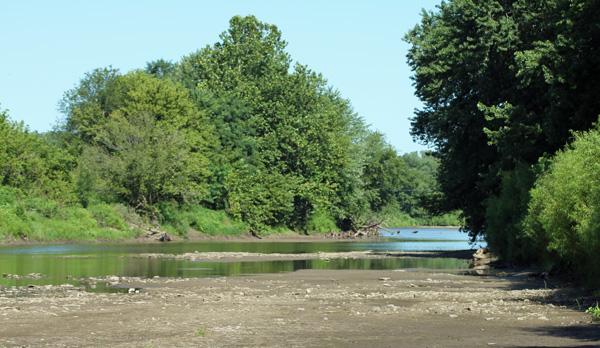
Elrod Mill Conservation Area in Andrew County is located on the Platte River. It was purchased by the Missouri Department of Conservation in 1980 to give access to the Platte River. In the 1800's this site was the location of a grinding mill that ground flour for local residents. The mill was powered by the flow of the river. William Elrod ran the mill and in 1885 when the first post office was built in this area not only was the post office named after Elrod he also became the postmaster.
This is one of the smaller conservation locations owned by MDC with only 59 acres, and without a doubt one of the most beautiful. The area is mostly timber with some crop ground. There is a huge sand bar that acts like a beach. Fishing is good here with catfish being the predominant fish. There is hunting allowed in the area with the proper hunting licenses and portable tree stands. This is a beautiful place to spend a day just hanging out. The Platte River is one of the most gorgeous rivers in NW Missouri.
Tuesday, August 2, 2011
Mute Swan
Swans are the epitome of grace, love and romance which is a contradiction of their actual temperament. These birds tend to be aggressive, defensive and often are the bullies of the waterfowl world. Mute Swans (Cygnus olor) as pictured here are common throughout much of Eastern North America. These birds are the descendants of captive populations of swans brought over from Europe and Asia. Mute swans were often used as display birds in city parks, cemeteries, water gardens, botanical gardens and zoos. These birds mated and did well in captivity and as is often the case some birds escaped their captive environs and found the native landscapes to their liking and have created naturalized populations throughout most of the eastern United States and parts of Canada.
These are large birds measuring up to 67 inches in length and have a wingspan up to 94 inches. They may stand nearly 4 feet tall when on land. They are also heavy birds that may weigh up to 26 pounds with females being a little smaller at around 20 pounds. This species is easily differentiated from the similar Trumpeter and Tundra Swans by their curved neck and orange bill with a distinctive black knob.
Mute swans mate for life and both sexes share in the maintenance of the nest and the care of the young cygnets. Juvenile swans are born dark gray or black in color and do not obtain their beautiful white plumage until they are adults. The popular nursery rhyme "The Ugly Duckling" was written about an abandoned swan cygnet that looked far different from the other ducklings it was living with. In the end after all the ducklings made fun of this unfortunate little orphan he had the last laugh when he turned into a magnificent white swan.
These birds feed on a wide range of vegetation including submerged aquatic plants, and field crops like wheat. During the winter months significant damage may be done to crops through trampling and feeding by these swans.
Mute swans get their name from their nearly silent demeanor. The only sound they are reported to make is some grunting, hoarse whistling and snorting. These sounds are generally used to communicate to the cygnets. They also give off a unique vibrant throbbing of the wings when in flight. Other species of swans are much more vocal and even have obnoxiously loud voices.
These birds can be quite intimidating in their behavior as they are often very aggressive in protecting their nest and young. Male Mute Swans referred to as Cobs are responsible for protecting the young cygnets when on the water. They take this job very seriously and have even attacked canoes, boats, swimmers and anything else they perceive as a threat to their offspring. On land they will stand their ground against Foxes, Canada Geese and a number of other predators including humans which on occasion have been attacked by these birds. I for one would not want to go up against one of these birds when it is protecting its cygnets. I've been chased and pinched by geese and it is an unpleasant experience to say the least, I imagine a swan would be much worse.
Saturday, July 16, 2011
Bullfrog Metamorphosis
While exploring the pond where I work I discovered numerous tadpoles in the process of completing their metamorphosis into froglets. These are juvenile bullfrogs and will soon be on their way to adulthood. The first picture shows the froglet with its long tadpole tail still very much visible.
This second image shows an additional froglet with just a nubbin for a tail. He is much further along on the transformation scale.
Finally, this young froglet has completed his transformation and has lost his tail entirely. There were dozens of these young bullfrogs all over the lily pads. Apparently they were all emerging at once from the water for the final time. Bullfrogs need two years to complete their lifecycle, which makes these youngsters two years old. It will take an additional year or more for them to reach the large size of the adult.
This image is a full grown adult which measures about 5 inches in length from mouth to tail bone. From the look of our pond at the office we are going to have a healthy population of these beautiful frogs....providing of course that the raccoons, turtles, skunks, and birds don't feast on them first. If you would like to learn more about Missouri Bullfrogs you might enjoy a post from last spring Bullfrogs
Thursday, July 7, 2011
Rochester Falls Conservation Area
Approximately 3 miles from my house is the conservation area known as Rochester Falls. These falls are part of the Platte River and are a popular place for campers, fisherman and nature lovers alike. This is a beautiful place to visit as the river flows over the limestone outcroppings creating these small but lovely falls. Typically when we think of "water falls" we think of giant plummeting streams of water that "fall" for great distances. These falls aren't as awe inspiring, but that certainly doesn't take away from their beauty.
Rochester Falls is owned by the Missouri Department of Conservation and is frequently patrolled by our county agent. This place is a hotspot for young people to drink, party and swim. It can be a struggle to protect people from themselves at times. In the past month two young people drowned within a week of each other at the falls. It is common for people to disregard the "no swimming" signs and venture into the river anyway. These are unfortunate tragedies that could have been prevented. When visiting areas such as this, it is always best to heed the warnings posted, they are there for a reason.
This area is mostly old-pasture, timber and grassland. Fishing often yields catfish, especially flatheads, and carp. My son and his friends set bank lines along this portion of the river and recently caught two huge flatheads, one weighed 35 pounds the other weighed 40 pounds. (pictured below)
Canoeing and kayaking are also favorite activities on the Platte River, and this is a good access point for putting in or taking out your watercraft. Motorized boats cannot be put in at this location. The Platte River would most likely be too shallow anyway. There are eleven campsites and two tents per site are allowed.
Wildlife abounds, including dragonflies, damselflies, butterflies, snakes, deer, raccoons, opossums, squirrels, rabbits, bobcat, fox, and flying squirrels.
Rochester Falls is owned by the Missouri Department of Conservation and is frequently patrolled by our county agent. This place is a hotspot for young people to drink, party and swim. It can be a struggle to protect people from themselves at times. In the past month two young people drowned within a week of each other at the falls. It is common for people to disregard the "no swimming" signs and venture into the river anyway. These are unfortunate tragedies that could have been prevented. When visiting areas such as this, it is always best to heed the warnings posted, they are there for a reason.
This area is mostly old-pasture, timber and grassland. Fishing often yields catfish, especially flatheads, and carp. My son and his friends set bank lines along this portion of the river and recently caught two huge flatheads, one weighed 35 pounds the other weighed 40 pounds. (pictured below)
Canoeing and kayaking are also favorite activities on the Platte River, and this is a good access point for putting in or taking out your watercraft. Motorized boats cannot be put in at this location. The Platte River would most likely be too shallow anyway. There are eleven campsites and two tents per site are allowed.
Wildlife abounds, including dragonflies, damselflies, butterflies, snakes, deer, raccoons, opossums, squirrels, rabbits, bobcat, fox, and flying squirrels.
Friday, June 24, 2011
Fox Kits
Last year we had a family of foxes living on our farm. I managed to take a few photos of the kits and was privileged to watch them off and on throughout the year. This year they came back and this time she has seven babies, which is three more than she had last year. I've been watching them for several weeks now. They roam all over our farm and one in particular is very accepting of my presence. It has a decidedly crooked tail. He/she lets me photograph it and get quite close to it. The others in the little are more skittish and less accepting. Here are a series of photos from the first time we spotted them, until today.
Friday, June 10, 2011
Dickcissel
This beautiful little bird is a Dickcissel (Spiza americana), they are a common sight throughout the midwest during the late spring and summer months. These birds migrate back into the United States late in May or early June, which is much later than most birds returning to their breeding grounds. Dickcissels nest near the ground and typically build their nests in grassy meadows, prairies, or other tall grass areas. Males are very colorful and somewhat resemble Meadowlarks with their black collar and yellow breast. Females on the other hand are drab by comparison and look more like sparrows.
Dickcissels are fond of seeds and insects. In their winter range they may be a pest to grain
farmers because of their habit of forming large flocks and feeding on the grain seeds. Early in fall these birds begin forming loose flocks that gradually grow in number by mid to late fall. It is not uncommon for a flock heading south to contain millions of birds. It is this tendency to congregate in such large flocks that causes so much trouble for grain farmers in their overwintering sites. Venezuela is especially plagued with these birds, and consequently use poisons and other methods of ridding themselves of these birds. In the midwest breeding grounds, Dickcissel faces several additional threats: cowbird parasitism, the destruction of nests and nestlings by mowing machines, and loss of habitat due to changing agricultural practices and succession.
The wintering population of these birds can become highly concentrated at certain favored roosting sites. A single "successful" poisoning event of a large flock of roosting birds could significantly reduce the world population of Dickcissel.
Formerly common in farming regions of the eastern states, especially on the Atlantic coastal plain, the Dickcissel disappeared from that region by the middle of the last century and is now most numerous in the Midwest. It appears in small numbers on the East Coast during the fall migration and rarely but regularly in winter at feeders, often with House Sparrows.
Because of the damage these birds cause to local farmers in their wintering ground, the Venezuelan Audubon is working in conjunction with local grain farmers and with the US Fish and Game in a monitoring program of the night flights of the dickcissel. These birds have a distinct call that they sing while in flight. These calls make locating and recording them relatively easy and flock sizes can be monitored.
What Can You Do?
Audubon's Important Bird Area program is a vital tool for the conservation of Dickcissel as well as other species. To learn more about the Important Bird Areas program and how you can help, visit: . http://www.audubon.org/bird/iba/.
To learn more about the Dickcissel Night Flight Call Monitoring project in south Texas, visit:
Subscribe to:
Posts (Atom)