Tuesday, July 24, 2012

Hoary Mountain Mint

Hoary Mountain Mint (Pycnanthemum incanum) is a native herbaceous plant Native to Eastern North America as far west as Tennessee and Illinois. The genus name Pycnanthemum means "dense flower-clusters" in Greek. This perennial is in the mint family and grows up to 6 feet in height. The tiny pale lavender blooms appear from July to September and are favored by butterflies, bees and other nectar loving insects. The stems are covered in a white downy substances and the leaves appear frosted. In Vermont and New Hampshire this plant is listed as endangered and efforts are in place to monitor that last remaining locations within these two states. It is also listed as endangered in Ontario where there is only two remaining locations known for this species in oak savannas in Burlington. In other areas where this plant occurs it can often become invasive and spreads by rhizomes. It is predominantly found in woods, thickets, open fields and along hills. It is presumed that it earned its common name of Mountain Mint from its preferred habitat of hill ground. 


As with other plants in the mint family it is often used in teas. When crushed this plant gives off a strong aroma. Mountain Mint contains tannin which is often used as an astringent. 

The Choctaw put the mashed leaves in warm water, which the patient drank, and which was poured over the head to relieve headaches. For patients who were sickly all the time, the leaves were mashed in water, the doctor took a mouthful of water, and blew it onto the patient, three times on the head, three times on the back, and three times on the chest. Before the next sunrise, the patient was bathed in the medicine.*

The Koasati mashed the leaves in water, and used the water to treat laziness. The patient bathed his face in the cold water and drank it. For nosebleeds, the plant was wetted, and put up into the nostrils to stop the bleed. The roots were boiled along with Black Willow, and drunk to relieve headache.*

Resources:
http://en.wikipedia.org/wiki/Pycnanthemum_incanum

Tuesday, May 29, 2012

Red-Bellied Woodpecker

This beautiful bird is a Red-Bellied Woodpecker (Melanerpes carolinus). They are medium sized woodpeckers that can be found throughout most of the eastern United States and Southern Canada. They breed in the northeastern United States and parts of southern Canada, although they are found as far south as Florida.

The name red-bellied is a bit of a misnomer, as they do not have a red belly at all, in fact their belly is more of a buff color with a slight tinge of pink that is well hidden and difficult to see. Their head and body is light gray and their back and wing feathers are black and white in a Ladder-like pattern. Like all woodpeckers they have two toes on the front and two toes on the back of each foot which allows them to grip the trees they climb around on. Males have red on their head that extends from the nape of the neck to the bill. The female has less red. The one pictured here is a female. Their bodies measure 9 to 10 inches in length with a wingspan up to 18 inches.

Woodpeckers mainly eat insects that they find in the cracks of tree trunks or by drilling their beak into the bark of trees and removing bugs hiding there. They will also eat suet, sunflower seeds, nuts and some berries if provided. They will sometimes wedge larger nuts into the bark of trees and break it down into smaller more manageable pieces with their beak. They will also store nuts and berries in old fence posts to eat at a later date. This is a trait they share with other species of woodpeckers. A Red-bellied Woodpecker can stick out its tongue nearly 2 inches past the end of its beak. The tip is barbed and the bird’s spit is sticky, making it easier to snatch prey from deep crevices. It could be described as similar to velcro....the tongue flicks out and sticks to whatever it is trying to capture.  Males have longer, wider-tipped tongues than females, possibly allowing a breeding pair to forage in slightly different places on their territory and maximize their use of available food.

Red-bellieds are loud, raucous birds that make numerous vocalizations. I often describe the song as that of a monkey yelling in the trees. So if you are out hiking and hear something that sounds like a monkey and you don't live in the tropics, chances are it is a woodpecker.

A couple of weeks ago my daughter came home to find a red-bellied woodpecker on the front porch near the door. It had flown into the window glass on the door and was stunned. I had her place it in a cardboard shoebox and put it in her bedroom in the dark. We left for about an hour and ran some errands. When we came back to check on the bird, I had her take the box outside before opening it. As soon as she took the lid off the woodpecker flew out and to the tree halfway across the yard. She seemed all recovered from her experience.

Shaylyn holding the bird right after it crashed into the window.


Beautiful back pattern 


 This woodpecker lived up to its nature by trying to peck its way out of the box it was in.


This species prefers deciduous woodlands to nest in and will use old maple, elm and other softer wood to excavate nesting holes in. They will drill smaller holes around the nesting site to discourage other woodpeckers from moving into their territory. This species is secure in their numbers, but rely heavily on deciduous forests, so those areas that are deforested will have very few to no nesting woodpeckers. They will occasionally use backyard trees to nest in, but not with any regular occurrence. Starlings are competition for these woodpeckers and more than half of all nests will be invaded by starlings. Males will seek out the nesting sites and will tap its beak to attract a female. Any females in the area that hear his tapping will come to check it out. If the female is receptive to his technique she will in turn tap softly in response. She will then help him put the finishing touches on the nest.

Occasionally you may spot a Red-bellied Woodpecker flying quickly and erratically through the forest, then it will suddenly change direction, landing for a moment and rapidly take off again keeping up a quick chatter of calls. Scientists document this odd behavior as a type of play that probably helps young birds practice the evasive movements they may one day need.resources in one area.

These birds are often preyed upon by Cooper's Hawks, sharp-shinned hawks and snakes. House cats are also a huge problem for these birds as well as other backyard birds. Other woodpeckers such as pileated woodpeckers, and red-headed woodpeckers as well as owls, and snakes will kill the nestlings.

Sunday, April 15, 2012

Witches Butter


While hiking last week with a school group we came across this bright yellow fungus growing on a rotting log. I had no idea what it was and was determined before the day was over I would no its identity.
I searched through several mushroom books and located it in a book written by Maxine Stone on Missouri's mushrooms. It is called Witches Butter (Tremella mesenterica) and is a type of jelly fungus. It is a common fungus associated with mixed deciduous hardwood forests. It is most frequently found in the cracks and crevices of newly fallen limbs., Right after a rainfall is a good time to spot this beautiful, small jelly-like mushroom. Within a few days of emerging it will dry and form a film on the log where it was found. If it rains again the fungus will revive and bloom again. It has a very slimy texture and lives up to its name of Jelly fungus. I love the common name of Witches butter, as I find it a fanciful and mythical name. You can almost picture a couple little witched sitting in the woodlands spreading "witches butter" on their toast over their morning tea time. This fungus does go by other equally fantastic names such as yellow brain, golden jelly fungus, and yellow trembler (because it trembles at the merest touch).

This fungus is found year around and may be seen during winter thaws or during mild winters like we experienced this past season. It may range in color from bright yellow to pale yellow. It is reported to be edible, but has no real discernible taste. It is used to add texture to soups and stews.

The snail in the following picture seemed fond of it however. Any self respecting snail or slug will not turn down a tasty mushroom dinner.

Friday, March 2, 2012

Striped skunk sprint

At the encouragement of a friend of mine I am retelling the story of the little skunk pictured here. A few years ago I was visiting a farm with my husband that his parents own. We were driving across the pond dam when I noticed a skunk in the field. I hurriedly told my husband, Joey, to stop the truck so I could run down into the field and take a picture. I made it into the field and the skunk did not see me. I figured this situation was off to a good start. I crept closer and kept snapping pictures. Again the skunk paid no attention to me. So I took this as a good sign and tip-toed closer. I knew I was skating on thin ice (figuratively speaking) and that this situation could get ugly, or at the very least stinky any second. By now I was about 20 feet away, and this apparently was a tad bit beyond the skunks comfort zone. She lunged forward onto her front feet and began dancing and stomping. I thought that was the cutest thing I'd ever seen, so naturally I had to get closer. Then I hear the voice of reason coming from the top of the pond dam...."If you get sprayed you are walking home!"

I persisted and went a little closer to the skunk, this was probably not the smartest thing I could have done....okay...it was DEFINITELY not the smartest thing I could have done. It reared back on its hind legs and stomped onto its front legs...not once.....but twice. I was clearly being warned. Did I listen? Nope. I walked a bit closer, and by now I was about 15 feet away and well within the distance needed to get sprayed. It was at this point that this skunk did something unimaginable......it ran at me! It startled me so much I turned tail and ran looking over my shoulder the entire time. This skunk was hot on my tail and was literally chasing me back where I came from....all the way to the pickup.  I once again hear the voice of reason at the top of the pond dam......"RUN...faster...RUN!" As if he needed to tell me that!!!! You NEVER saw an old woman run so fast!

I made it to the truck unscathed and not wearing Ode' to Skunk. I jumped in the truck and looked out the window. I saw the skunk walk along the pond dam. I was curious once again and I got out of the truck and followed her, this time from a safe distance that did not invade her space. She began digging in earnest and disappeared underground. We came to the conclusion she had babies and this was her den. All the fancy foot work and the sprint race up the hill was all in an effort to keep her babies safe and to warn me away.

She had ample opportunity to spray me, and chose not to. If you are ever outside and come across a skunk, if they start dancing around, you better start running in the other direction. You are either about to be sprayed or chased, and trust me you WILL run with one of these little stink bombs coming after you.

Friday, October 28, 2011

Cattle Egret


On recent trip to Squaw Creek NWR in Mound City Missouri I spotted these three cattle egrets cleaning their feathers and sunning themselves on a stump in the marsh. They were approximately 10 feet off the shoreline and very tolerant of human activity. I was able to photograph them from the car without disturbing them at all.

Cattle Egrets (Bubulcus ibis) are closely related to herons such as the Great blue Heron, Purple Heron and the Green Heron. Cattle egrets will be found in tropic, sub-tropic and temperate zones and are often associated with cattle, hence the name. They feed on the insects disturbed by the large hooved animals.This species also removes ticks and flies from cattle, but it can be a safety hazard at airfields, and has been implicated in the spread of tick-borne animal diseases. It is not uncommon to see huge flocks of over a hundred of these egrets in a pasture with cows. I saw such a flock several years ago when we visited Oklahoma.
They do nest in large colonies near bodies of water much like other herons and egrets do. Their nest is a platform of sticks. These birds as adults have few natural enemies, but the eggs and chicks are often preyed upon by raccoons, snakes, and other predators.

The Cattle Egret is a stocky heron with 35–38 inch wingspan;and weighs 9.5–18.1 ounces. It has a relatively short thick neck, sturdy bill, and a hunched posture. The non-breeding adult has mainly white plumage, a yellow bill and greyish-yellow legs. During the breeding season, adults of the western subspecies develop orange-buff plumes on the back, breast and crown, and the bill, legs and irises become bright red for a brief period prior to pairing. The sexes are similar, but the male is marginally larger and has slightly longer breeding plumes than the female; juvenile birds lack coloured plumes and have a black bill. The positioning of the egret's eyes allows for binocular vision during feeding, and physiological studies suggest that the species may be capable of nocturnal activity. This species gives a quiet, throaty "rick-rack" call at the breeding colony, but is otherwise largely silent.

The species first arrived in North America in 1941 (these early sightings were originally dismissed as escapees), bred in Florida in 1953, and spread rapidly, breeding for the first time in Canada in 1962. They were orginally from Southern Spain and Portugal. The massive and rapid expansion of the Cattle Egret's range is due to its relationship with humans and their domesticated animals. Originally adapted to a commensal relationship with large browsing animals, it was easily able to switch to domesticated cattle and horses. As livestock kept spreading throughout the world it was able to occupy otherwise empty niches.  Many populations of Cattle Egrets are highly migratory and dispersive, and this has helped the species' range expansion. Its global population estimated to be 3.8–6.7 million individuals.


Saturday, August 13, 2011

Elrod Mill Conservation Area


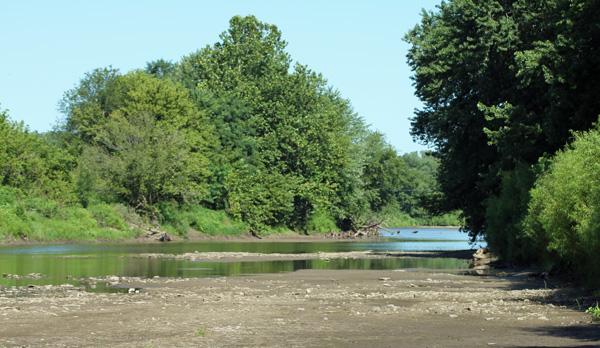
Elrod Mill Conservation Area in Andrew County is located on the Platte River. It was purchased by the Missouri Department of Conservation in 1980 to give access to the Platte River. In the 1800's this site was the location of a grinding mill that ground flour for local residents. The mill was powered by the flow of the river. William Elrod ran the mill and in 1885 when the first post office was built in this area not only was the post office named after Elrod he also became the postmaster. 


This is one of the smaller conservation locations owned by MDC with only 59 acres, and without a doubt one of the most beautiful. The area is mostly timber with some crop ground.  There is a huge sand bar that acts like a beach. Fishing is good here with catfish being the predominant fish. There is hunting allowed in the area with the proper hunting licenses and portable tree stands. This is a beautiful place to spend a day just hanging out. The Platte River is one of the most gorgeous rivers in NW Missouri.


Tuesday, August 2, 2011

Mute Swan


Swans are the epitome of grace, love and romance which is a contradiction of their actual temperament. These birds tend to be aggressive, defensive and often are the bullies of the waterfowl world. Mute Swans (Cygnus olor) as pictured here are common throughout much of Eastern North America. These birds are the descendants of captive populations of swans brought over from Europe and Asia. Mute swans were often used as display birds in city parks, cemeteries, water gardens, botanical gardens and zoos. These birds mated and did well in captivity and as is often the case some birds escaped their captive environs and found the native landscapes to their liking and have created naturalized populations throughout most of the eastern United States and parts of Canada.

These are large birds measuring up to 67 inches in length and have a wingspan up to 94 inches. They may stand nearly 4 feet tall when on land. They are also heavy birds that may weigh up to 26 pounds with females being a little smaller at around 20 pounds. This species is easily differentiated from the similar Trumpeter and Tundra Swans by their curved neck and orange bill with a distinctive black knob.
Mute swans mate for life and both sexes share in the maintenance of the nest and the care of the young cygnets. Juvenile swans are born dark gray or black in color and do not obtain their beautiful white plumage until they are adults. The popular nursery rhyme "The Ugly Duckling" was written about an abandoned swan cygnet that looked far different from the other ducklings it was living with. In the end after all the ducklings made fun of this unfortunate little orphan he had the last laugh when he turned into a magnificent white swan.


These birds feed on a wide range of vegetation including submerged aquatic plants, and field crops like wheat. During the winter months significant damage may be done to crops through trampling and feeding by these swans.


Mute swans get their name from their nearly silent demeanor. The only sound they are reported to make is some grunting, hoarse whistling and snorting. These sounds are generally used to communicate to the cygnets. They also give off a unique vibrant throbbing of the wings when in flight. Other species of swans are much more vocal and even have obnoxiously loud voices.

 These birds can be quite intimidating in their behavior as they are often very aggressive in protecting their nest and young. Male Mute Swans referred to as Cobs are responsible for protecting the young cygnets when on the water. They take this job very seriously and have even attacked canoes, boats, swimmers and anything else they perceive as a threat to their offspring. On land they will stand their ground against Foxes, Canada Geese and a number of other predators including humans which on occasion have been attacked by these birds. I for one would not want to go up against one of these birds when it is protecting its cygnets. I've been chased and pinched by geese and it is an unpleasant experience to say the least, I imagine a swan would be much worse.