Saturday, May 21, 2011

Gray Tree Frog

This little green frog hiding on the cornstalk is a Gray Tree Frog (Hyla versicolor)....I know......I know......it sounds like a misnomer, since he is obviously green and not gray. Truly the name is correct, and so is the color. They are color change artists, and will adapt their color to blend in with their environment. They cannot change color as rapidly as a chameleon but they get the job done nonetheless.

The ones I find near the house are usually gray, and the ones I see out in the grassy areas are green.  Those found near unnatural objects or if found dead they will most likely be gray in color. They have a bright yellow patch on their hind legs. These frogs should not be confused with another native frog called the "green tree frog (Hyla cinerea)". It is also green in color, but this frog is medium-sized, up to 6 cm (2.5 in) long. Their bodies are usually green in shades ranging from bright yellowish olive to lime green. The darkness of the color can change depending on lighting or temperature. There may be small patches of gold or white on the skin, and they may also have a white, pale yellow, or cream-colored line running from the jaw or upper lip  to the groin. They have smooth skin and large toe pads. The abdomen is pale yellow to white. Males have wrinkled throats (indicating the vocal sac) and are slightly smaller than females.


This arboreal species is native to almost all of the Eastern, and Northeastern United States and part of Southeastern Canada. Males begin singing for mates in May and continue calling for several weeks. I began hearing them call about 2 weeks ago. The calling is still somewhat sporadic and hasn't reached its crescendo as of yet. It could be because of the erratic weather we've been having. Daytime temps in the 90's, then in the 50's. Overnight lows from 70 down to around 38. Crazy Missouri weather....trust me if you don't like the weather wait a day, it WILL change.I'm sure all this fluctuation has them confused....Do we wake up? Do we sleep? Do we mate? Do we sing? Do we sleep? Eventually our weather will straighten out and then the super hot humid weather of summer will be here. It is at this time I see the tree frogs everywhere. They are most commonly active in the evening and at night. I find them in birdhouses, under the shutter of my home, in the gutters and clinging to the side of the house.


In Missouri the gray tree frog is found statewide and are the most commonly encountered tree frog throughout its range. They will be active all spring, summer and fall. When the night temperatures begin falling they will burrow into the soil and become dormant all winter, in a type of hibernation. Gray tree frogs do not have to burying themselves below the frost line as their "blood" is made up of a type of antifreeze called plasma glycerol. This substance prevents damage to tissues. Frogs are extremely sensitive to pollution and as such are considered indicator species. Areas with high pollution will have no frogs or very few frogs. Oxygen is breathed through their skin therefore any pollutants in the water or air will also be breathed in at alarming rates. We've all heard stories of frogs with more than two eyes, or numerous spare body parts. These mutant frogs have been heavily exposed to some kind of pollutant.

Frogs benefit humans in many ways, one of which is by being the indicator species they are. This gives us humans a "heads-up" as to what is going on in the environment, and hopefully gives us time to rectify any problems that are occurring. They also eat numerous insects, especially pesky mosquitoes and night flying moths.

I remember my husband always telling me to not handle these frogs because they are poisonous. He would insist it was true as that is what his grandpa told him, and if grandpa said it, it MUST BE TRUE! I would assure him the only way the frog was poisonous is if I suddenly decided to eat it, which of course I had no intention of doing. I also told him the frog is in more danger of being damaged by the oils or secretions on my hand, than I am in being poisoned by handling it. It never ceases to amaze me though, how rumors, myths and old wives tales run rampant in these parts.

Sunday, May 8, 2011

Robin nest

Joey came and found me last week to tell me that a bird had built a nest on his 8 foot step ladder. He did not see the bird so he did not know who created it. I went to investigate and noticed a Robin sitting on the nest. She flew away when she spotted me, so I climbed the later and discovered four beautiful blue eggs. It only took her a week and a half to build the nest and lay her eggs.

I went back several days later to check on them and discovered that three of the eggs had hatched. Momma robin was sitting on the nest, while daddy robin was sitting in a tree keeping watch outside the shed.  


Fuzzy little babies waiting for mom. One little blue egg remains to hatch.


OPEN WIDE!


Tuesday, May 3, 2011

The Forest is coming ALIVE

The Mayapples are beginning to bloom. At the office where I work there are two varieties, one blooms white and other pink. Until this year I did not know they smelled so heavenly, but they sure do, just like perfume!

The Jack-in-the-pulpits are nearly ready to open

The Spring Beauties have been blooming for several weeks now, they are such delicate little flowers.

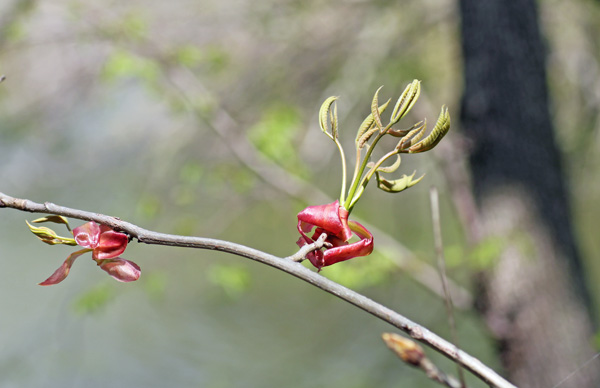
The Hickory Trees are opening up

A beautiful "fishing spider" disturbed from his winter hiding spot

Galls formed on an oak leaf, some tiny little wasp laid her eggs on the leaf, and the leaf protects itself by forming a cyst over the egg. When the egg hatches, the larvae feed and grow, causing the cyst to also grow. 

Unknown peach-colored mushrooms

Wild Phlox growing beside a log. The spring flower is blooming all over the woodlands right now.


Morel--the treasure of the woods!

Wild plum is one of the first trees to bloom in the spring, which gives nectar to hungry bees just waking up from their winters sleep.

I believe these purple violets are Birdsfoot violets. They sure make the forest
colorful.


Anywhere there are paw-paws growing in the forest, you are sure to find this gorgeous Zebra Swallowtail.

Snakes, like this little garter snake hide out on cooler days in the spring. This one was hidden behind the bark of a rotting tree.

You may find other unexpected surprises like a five-lined skink. These little guys hide out under logs and under the bark of trees. This one was living with the garter snake pictured above.

An empty snail shell, left behind.

An Eastern Comma Butterfly looking a little worse-for-wear after a long winter. 

Exploring the woodlands in the spring is one of the best ways to spend an afternoon. Everything is waking up after a long winters nap. Wildflowers are beginning to blooms, trees are leafing out and the creatures who live there are becoming active. Don't miss out....get outside and EXPLORE!

Saturday, April 30, 2011

Snow Geese

Snow Geese are one of the most commonly seen of all the water fowl in the United States. It is not uncommon to see flocks containing hundred's of thousands of birds. They are native to North America and are sometimes referred to as the Blue Goose. The two common names of Blue and White refers to the range of colors that this bird comes in. They will range from completely snow white with black markings on their wings to bluish color and even speckled varieties like the pictured here.

They breed in the northern most parts of their range, Greenland, Canada and Alaska. White- and blue-morph birds interbreed and the offspring may be of either morph. These two colors of geese were once thought to be separate species; since they interbreed and are found together throughout their ranges, they are now considered two color phases of the same species. The color phases are genetically controlled. The dark phase results from a single dominant gene and the white phase is homozygous recessive. When choosing a mate, young birds will most often select a mate that resembles their parents' coloring. If the birds were hatched into a mixed pair, they will mate with either color phase. They will migrate south during the winter and it is at this time that they come into Missouri in HUGE numbers. Squaw Creek NWR refuge sees up to a million of these birds each winter. 

 White- and blue-morph birds interbreed and the offspring may be of either morph. These two colors of geese were once thought to be separate species; since they interbreed and are found together throughout their ranges, they are now considered two color phases of the same species. The color phases are genetically controlled. The dark phase results from a single dominant gene and the white phase is homozygous recessive. When choosing a mate, young birds will most often select a mate that resembles their parents' coloring. If the birds were hatched into a mixed pair, they will mate with either color phase. Snow geese breed from late May to mid August, but they leave their nesting areas and spend more than half the year on their migration to-and-from warmer wintering areas.

During spring migration, large flocks of snow geese fly very high along narrow corridors, more than 3000 miles from traditional wintering areas to the tundra.
Outside of the nesting season, they usually feed in flocks. In winter, snow geese feed on left-over grain in fields. They migrate in large flocks, often visiting traditional stopover habitats in spectacular numbers. Snow geese often travel and feed alongside white-fronted geese; in contrast, the two tend to avoid traveling and feeding alongside Canada grey goose, who are often heavier birds.


The population of Greater Snow Geese was in decline at the beginning of the 20th century, but has now recovered to sustainable levels. Snow Geese in North America have increased to the point where the tundra  breeding areas in the Arctic and the salt marsh wintering grounds are both becoming severely degraded, and this affects other species using the same habitat.
Major nest predators include Arctic foxes and Skuas. The biggest threat occurs during the first couple of weeks after the eggs are laid and then after hatching. The eggs and young chicks are vulnerable to these predators, but adults are generally safe. They have been seen nesting near Snowy Owl nests, which is likely a solution to predation. Their nesting success was much lower when snowy owls were absent, which leads scientists to believe that the owls, since they are predatory, were capable of keeping predators away from the nests. Few predators take snow geese away from the nests, but Bald Eagles do take them given the chance.

 The dark color of the blue morph Snow Goose is controlled by a single gene, with dark being partially dominant over white. If a pure dark goose mates with a white goose, the offspring will all be dark (possibly with white bellies). If two white geese mate, they have only white offspring. If two dark geese mate, they will have mostly dark offspring, but might have a few white ones too.

Snow Goose hunting in the eastern United States was stopped in 1916 because of low population levels. Hunting was allowed again in 1975 after populations had increased. Populations have been growing so large that the geese are destroying nesting habitat. Hunting has not slowed the dramatic increases in population size.

Populations have been growing exponentially in most parts of the range. Some colonies are becoming so large that the geese are destroying nesting habitat, and hunting is proposed to decrease the populations.

Which is smarter, a snow goose or a crow? This seems like a ridiculous question. In folklore, the goose is regarded as “silly,” and the crow is regarded as wily.

When Aphrodite first came ashore she was welcomed by the Charities (Roman "Graces"), whose chariot was drawn by geese.


 References:
Cornell University
Aboutbird.com
Wikipedia

Thursday, April 28, 2011

Silver-Haired Bat

Today when I arrived at work Dr. C from the University was in my office and asked me if I would like to see a silver-haired bat hanging onto the side of a tree? "Of course!" Did he even have to ask? We grabbed Dr. Ashley and headed out into the timber to see the bat. It was clinging to the side of a tree about 4 feet off the ground. This is the first time I've ever seen this particular species. 

Silver-haired bats (
Lasionycteris noctivagans), which also go by the name of Silverwings are medium sized bats covered in dense black hairs . The hairs on their back are tipped in silvery gray. 


The species name of this bat translates into "night wandering shaggy bat."


Their preferred habitat is forested areas, which is exactly where we found this bat. There is a patch of timber directly behind our office building that the University uses for their ecology class, biology class and herpetology classes. I use the trail through the timber for trail hikes with visiting school groups. 

Silver-haired bats hide out during the day in cavities within trees, and under the bark of trees. Why this particular bat was clinging to the side of the tree completely exposed to the elements and prying eyes is a mystery, especially since there are shagbark hickory trees within 10 feet of where this bat was located.

Shagbark hickory's are one of the most common trees in the timber near our office. I like to point them out to the children, and talk about how special they are.They have such "shaggy" bark and grow incredibly tall. I always ask the kids if they like the cartoon Scooby Doo? They all raise their hands. Then I ask them who Scooby's best friend is....they all answer "Shaggy". Then I ask them to look in the woods around them and find the "shaggy tree" It takes them a few minutes, but they all find it. I confirm that they are right, then tell them the tree is called a Shagbark Hickory. 
Then I tell them to hold up their fists, and explain to them that an animal the size of their fist lives under the bark of the shagbark hickory tree during the day and comes out at night to hunt insects. Do they know what it could be? I get many responses from Birds, bugs to snakes, but eventually they settle on bats, and of course they are right. 

Had the silver-haired bat chosen to rest under the bark of the Shagbark it would have been a better choice, but for some reason it seemed content right where it was. We were able to get close to it and photograph it, and at no time did it seem alarmed or bothered. Our voices didn't even bother it. Hopefully it wasn't sick, although Dr. Ashley didn't seem to think it was.

This bat is found throughout the United States with exception to Florida. Their northern most range is Alaska and parts of Canada. They even range into Mexico. They feed on a wide variety of insects including moths, caddisflies, mosquitoes, crickets and beetles. 

These bats form maternity colonies in tree cavities or small hollows. Mating takes place in early fall and fertilization is delayed until the following spring. Two pups are born between late June and early July. Just before birth takes place the female will begin to roost with her head facing upward. She will hold her tail membrane forward to form a cup-shaped basket which will catch the pups as they are born.


Adults may live up to 12 years, providing they aren't preyed upon by skunks, feral cats, owls or raccoons. Silver-haired bats are one of the slowest flying bats in the animal kingdom, which could account for their susceptibility to predation. Unlike other bats this species roosts singly instead of with other members of their kind. 

This species is somewhat migratory. In its northern most range it will migrate south and spend the winter in caves or other secluded locations. Little else is known about their hibernation habits. These bats are one of the most common bats found in the United States. They are known to carry a special strain of rabies that is reported to be only in this species and the Eastern Pipistrelle . 

Reported deaths have occurred due to this strain of rabies. Silver-haired bats have very tiny, sharp teeth capable of biting without undue pain. Many people are bitten and do not even release they've been bitten. The puncture wounds are so tiny as to be almost unseen. These particular cases of rabies have been primarily reported from the more northern and northwestern regions of their range. It is always best to not handle a bat, this is especially true of a bat found during the daylight hours. Better safe than sorry. That being said, bats are one of the most important predators of insects in the animal world. The presence of rabies in bats is relatively low, with approximately 1/2 of one percent of bat populations carrying the virus. The good outweighs the bad and bats should be tolerated. I have put up bat houses hoping to attract them to our farm, but so far they have not used them. Hopefully one day they will take up residence here.


Wednesday, April 27, 2011

False Morels


This blob-like, brain-like, fungus is a False Morel in the genus Gyromitra. There are several mushrooms within this genus and all are referred to as false morels. They also go by many other common names, such as Red morel, beefsteak, brain mushroom, glob mushroom, and redheads. 
They have well developed stems, and their oddly shaped caps are generally reddish brown to yellowish brown. When sliced open, they are not completely hollow--and this is the best way to distinguish them from the morels, which are hollow.

Many people eat these mushrooms with no ill effects, but studies are showing that others have severe reactions to eating these mushrooms, and in some cases death could result. Other reactions to consuming these mushrooms could be dizziness, nausea, and coordination problems. In southern Missouri these are eaten regularly with Yellow Morels and are considered quite tasty. Perhaps certain people have built up immunities to the toxins within these mushrooms. Perhaps they are just lucky. Perhaps their bodies are just able to consume them and not suffer for it. I for one would not want to chance it. I would rather err on the side of caution and live another day...or at the very least, not spend days suffering ill effects from a potentially poisonous mushroom. 

“There are old mushroom eaters and there are bold mushroom eaters, but there are no old bold mushroom eaters”


The one pictured here is very large, it measures nearly 9 inches tall, and 6 or 7 inches in diameter. The base is 4 or 5 inches in diameter. I believe it is Gyromitra esculenta. Which generally fruits near conifer trees. It is referred to as beef steak morel in some areas and is consumed after special preparation. There have also been confirmed fatalities. Some of the toxin is removed by boiling multiple times in water and discarding the water. Reportedly cooks have been poisoned simply from breathing the steam. One of its toxins is monomethylhydrazine (MMH) which has been used in rocket fuel. It is available canned and dried from Finland and probably other countries as well. 

So what's the problem? One danger is the varying levels of MMH in different poisonous mushrooms. Some species contain very little, others contain enough to kill. MMH levels also vary among geographic regions within a single species. The point is nobody knows how toxic any false morel will be in any location. MMH is a cumulative toxin. This means that its levels will build up in your body after repeated consumption. This could lead to illness or even death. Keep that in mind the next time someone insists to you that they've safely eaten these poisonous mushrooms.

Most appear in the spring and summer and grow directly on the ground. Although some are found on wood or later in the year, they are unlikely to be mistaken for true morels. Caps are usually brown or reddish brown and occasionally yellow. Most stems are a light color, ranging from white to tan. These mushrooms are considered saprotrophs, meaning they feed on dead and decaying organic matter. Some have suggested that they may be mycorrhizal as well (forming a symbiotic relationship with trees).
Like true morels, false ones are often found in areas where the forest floor has been disrupted. You're more likely to see them near washes, rivulets, man-made disturbances in the ground, and roadsides.

Make note of the cap shape. False morels have caps that are "wavy" or "lobed". They appear to be bulging outwards. True morels have a more uniformly shaped cap with pits or ridges. They appear to be pitted inwards rather than bulging.The cap of the false mushroom hangs freely from the stem. A true morel has a cap that will be attached to the stem. This is not always the case but more often than not it is.

Don’t eat any mushroom unless you are ABSOLUTELY sure that it is safe!
You should never eat any mushroom unless it is positively identified as edible. If you are in any way uncertain about the edibility of a mushroom, don’t try it. If in doubt, throw it out!
While morels are easily identified, other species of safe mushrooms have deadly look-a-likes. If you are just starting to collect and eat wild mushrooms, don’t rely on books or websites alone for your information. Go hiking with experienced experts, who can show you how to identify the important characteristics of edible and poisonous mushrooms.


References:
http://www.mushroom-appreciation.com/false-morel.html

Monday, April 25, 2011

House Sparrow


House Sparrows (Passer domesticus) is a small non-native bird that resides near human dwellings. Its species name of domesticus even hints at its preference for associating with human activity. They are native to Europe, Asia and parts of the Mediterranean and have been introduced throughout the World, both purposely and accidentally. They are perhaps the most widely distributed bird species in the World.

House Sparrows aren’t related to other North American sparrows, and they’re differently shaped. House Sparrows are chunkier, fuller in the chest, with a larger, rounded head, shorter tail, and stouter bill than most American sparrows. So these gregarious birds should not be mistaken for native species of sparrows. The house sparrow competes for nesting sites with native birds and often displaces them. Bluebirds are especially targeted by this bird, house sparrows will enter the bluebird house and peck holes in the eggs or kill the babies. They also take over purple martin houses, chick-a-dee houses and any other birdhouse they can fit into. I noticed one the other day in my own backyard trying to fit into a wren house entrance. It's eyes seriously misjudged the diameter of the hole, compared to the size of its own body. She worked and worked at trying to fit. I had to admire her for the positive attitude...kind of like a woman who is convinced she can wear a pair of jeans one size smaller, and will do everything she can to make them fit!


I personally do not tolerate house sparrows and as soon as I discover nests in my bluebird houses or other bird houses I destroy the nest, eggs, and any nestlings. I admit this is an ongoing battle and I find myself clearing out a nest almost daily for over a month or more. Some people may find this cruel to the bird, and cannot imagine killing any bird, and that is fine. If you prefer to let them take over your nest boxes and breed and add to the ever growing population of house sparrows then that is your choice. I for one prefer to give the native species a fair chance. House sparrows and starlings are two species of birds that are not protected under the migratory bird act, or by any other Federal or state laws. They are much more aggressive than the smaller nesting birds that typically fall victim to the house sparrow invasion. I do however have a pair that takes up residence in my clothes line pole every year, and I leave them alone. Mostly because they are not invading the bird houses.

Birdwatchers have no particular love of house sparrows and that comes back to the invasive tendency of the species. These birds feed on a wide variety of seeds and other foods. They are very fond of wheat and oat seeds and will often invade fields in large numbers. Farmers often shoot, bait or trap the adults to keep them out of their fields. Sparrows are also known to spread diseases such as West Nile and Salmonella to humans and to livestock, which is one more reason they should not be tolerated in large numbers.

House sparrows do have natural enemies in the form of birds of prey, in particular American Kestrels. Cats will also capture many house sparrows. In Europe they are often victims of roadkill and in parts of the Mediterranean humans feed on them as part of their normal diet.

House sparrows were introduced into the United States in 1851 in New York to help control caterpillar populations. After the initial release there were many subsequent releases in various parts of the country, with each release they became more and more established. They have now spread their range throughout all of the United States. They are listed as a species of least concern with the IUCN because of their large population and range. These birds return to their birthplace after every migration (a characteristic known as philopatric). Because of this, local populations have adapted to the color of their habitat resulting in 15 distinct subspecies in the West.

Depending upon how you feel in regards to these little birds, you may want to implement a control plan on your own property. This is especially true if you have bluebird houses.